


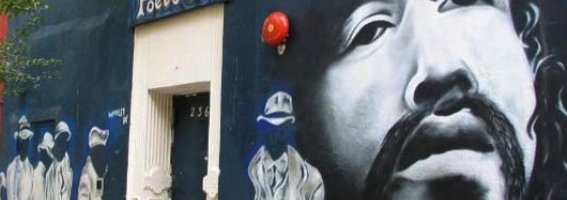
The Nuyorican Poets Café, the legendary venue that opened first in the mid 1970s, closed in the early '80s and then re-opened in the late '80s, is one of the cultural gems that keep NYC the hotbed of creativity that it has always been.
Ed Morales, author, lecturer, documentarian, journalist, Nuyorican, New York Native, took the time to talk with NYNatives.com about the Café, about the birth and flowering of Latino art and culture in NYC, and about what it is and what is has meant to be Nuyorican.
 The Café has come to embody the essence of independent,
organically grown and multicultural arts expression in the city. At its
founding, as Morales describes it, "was the full flowering of [a]
generation of poets, which include[d] Miguel Algarín, Pedro Pietri, Miguel
Piñero, Victor Hernández Cruz, Sandra Maria Esteves, and Papoleto
Meléndez." Since then, the Café has seen its own internal wrangling and
conflicts, but has always come back providing generation after generation with
a forum for groundbreaking poetry, visual art, music, literature and theater.
New York City is a city of many cultures. People emigrate here from all over the world, but when they get here, they assimilate a bit, keep a bit of their native cultures and create something entirely and totally unique and new. That convergence of culture and forging of novelty is beautifully characterized by the Nuyorican experience in NYC.
But what is it to be Nuyorican in NYC?
"As the name implies, Nuyorican means being a New York Puerto Rican, which entails some important distinctions from island-born or island-resident Puerto Ricans. The most important one for poetry is being bilingual. This bilingualism includes a wide array of New York ethnic and racial English accents, which vary according to where you grow up or how you're schooled. Willie Colón, a legendary salsa musician, grew up in Mott Haven during a time when there were many Irish and African Americans in the neighborhood. Some people acquire Jewish or Italian accents, and over the last 25-30 years most Nuyoricans have adopted a hiphop cadence in their English. But then the Spanish slips in, usually in a strong emotional context, and the references to Puerto Rican ancestry and tradition. This process is called tropicalization of the urban environment, where you feel you are in a Puerto Rican landscape that gets transferred to mean and glamorous city streets. Bilingualism opens the door to multiculturalism, the ability to identify with many different cultures and aesthetics, so being a Nuyorican means owning that Puerto Rican identity, the music, the language, the "flavor," while also internalizing most of New York City's postwar aesthetic, whether that’s the Yankees or Times Square or jazz or hiphop or fashion or club scenes, or a literary feel that merges beat bohemian rap with centuries of Spanish and Latin American literature and Afro-Caribbean oral tradition."
And of course there is a rich history to this experience- one that extends back to the first waves of Puerto Rican immigrants coming to the States.
 "Puerto
Ricans have been coming to New York since the early 20th century, and there
were a couple of writers like Bernardo Vega and Jesús Colón who were socialist
organizers and workers and left a lot of text that was not necessarily
bilingual but began this process of tropicalization of the New York experience.
Julia de Burgos, who has a cultural center named after her in East Harlem, was
the first established island-born Puerto Rican who produced significant work
living in New York and she also broke barriers for women writers and (like
Jesús Colón) identification with African ancestry. Clemente Soto Vélez, who has
a center named after him in the Lower East Side, wrote mostly in Spanish but
experimented a little with bilingualism. Piri Thomas wrote the incredibly
influential Down These Mean Streets
about his own identity crisis as a black Puerto Rican with an Anglo name, helping
to define the "Naked City" era in New York when filmmakers and
writers focused on "social problems" like teenaged crime and drug
abuse. Tato Laviera is another very important poet, probably the most fluent in
both languages, and he issued a major challenge to island Puerto Ricans by
implying that Puerto Rican migrants, because they were mostly from the lower
classes, were the true carriers of Puerto Rican tradition."
The Café provided a forum for this super-abundance of creativity and flourishing of bilingualism- as a means of both cultural and creative expression. Morales has written extensively on Latino culture, stereotypes, creativity, assimilation, influence and multiculturalism in his books Living in Spanglish: The Search for Latino Identity in America and The Latin Beat: The Rhythms and Roots of Latin Music, from Bossa Nova to Salsa and Beyond. During the years that Morales spent reading at the Café, it fed his creativity in numerous ways.
 "During my peak years [at the Nuyorican Poets
Café], between like '90 and '93, I came into contact with so many brilliant and
talented writers and performers; Paul Beatty, Willie Perdomo, Edwin Torres,
Mike Tyler, Tracie Morris, Reggie Gaines, Maggie Estep, and we all had an
effect on each other's work, whether it was direct feedback and encouragement
or competition, or answer poems. But there were literally hundreds of poets
who came through there and were also influential on me. I think the main thing
about what was going on in those days is that we were all in some way
addressing political issues, whether they were the first Gulf War, or
gentrification or identity politics or women's and LGBT issues. But it was all
in the context of writing and performing a good poem with a good story attached
to it, it was almost never a political diatribe. The idealism that was fought
for so many years by so many people (ABC No Rio, CHARAS, the musicians, the
filmmakers, the visual artists) who had been involved with the neighborhood had
one venue where it could all be expressed, and everyone milled around the bar
afterward and hung out. Plus Miguel Algarín, Pedro Pietri and Steve Cannon were
tremendous elders in residence who spiritually shaped the whole thing."
 A nourishing
force for new and unknown artists it certainly was, but the Café also forced
the larger arts community to take note of some serious talent in a locale that
would otherwise be completely off the beaten-arts-track. Founded and located
"deep in the heart of Loisaida" as Morales notes, the Café made the larger
arts community acknowledge the real conditions that artists live and work
within and in turn, are inspired by. The Bronx (which is where Morales is
originally from), Spanish Harlem and the Lower East Side (or Alphabet City)
were all core Nuyorican communities in the mid-twentieth century. The Lower
East Side in the '70s, '80s and early '90s was a far cry from what it is today, as
we explored in our feature on the Lower East Side and the Rise of NY Hardcore.
In that drug and gang infested urban ecology grew some of the most influential
cultural players that New York has had to offer. And that same location was key
in the development of the Café and its culture that would eventually tour
around the country and the globe.
In fact, Morales mentioned that there is even now a Nuyorican Poet's
Café in Old San Juan!
Morales explains: "The original core of the '90s Café scene was made up of mostly writers who had grown up in and around New York. We all had a city attitude. There was a lot of that dark junkie streets at dawn stuff, and a lot of people read poetry about their lives as struggling writers who had trouble getting the $5 cover charge to get into the place. But there was also the beautiful energy of African American and Nuyorican spirit, which is about celebrating life despite how difficult it can be." The celebration of life through difficulty is a sentiment that can be applied to Nuyorican culture in all its many forms in this city. And over the years, the exuberance has extended to the larger – ever multiplying multi-cultures of New York. With waves of newcomers from all over Latin America and Africa and Asia, the Café's reach, as progenitor of new artists and as recipient of attention from the wider art world, has continued to grow. Notably, Sapphire used to read at the Café. And it was then, during the early '90s that she began to write the novel Push, on which the recent critically acclaimed film Precious was based.
 The unique
culture of New York City as expressed through those founding Nuyorican voices,
has also expanded and embraced the new New Yorkers re-forming the city
today. As Morales describes:
"Nuyorican culture has a tendency to become multicultural naturally, that
is, open and welcome to all manner of New York City culture. So while it was
theoretically expressed through Nuyorican voices, the Café allowed it to
physically open up to many people from different backgrounds, hence Algarín and
Homan's oft-quoted line about "everyone can be Nuyorican," and Allen
Ginsberg's blurb on the cover of the Aloud: New Voices From the Nuyorican Poets
Café anthology: "The most integrated place on the planet."
Beyond the Café and the artistic culture it engendered, moving out into the wider fabric of this city called New York, "Nuyorican" became a way of living, a politics and a movement.
"The Nuyorican poets movement was just one phase of the creation of Nuyorican in the 1970s, I see it expressed as well in the political activism of groups like the Young Lords, who fused the ideals of the Puerto Rican nationalist movement with the radicalism of the 1970s—they are modeled on the Black Panthers and one of their leaders was active at the '68 Columbia strike and SDS. The second tendency, in addition to poetry and literature, was music. There's a whole history there of Nuyoricans, like Tito Puente, who was from Harlem and fused his love for big band music with Latin music to make mambo, and then in the salsa era most of the major stars like Willie Colon and Eddie Palmieri were New York born and they fused their love for jazz and R&B with Latin music to create salsa. Salsa was created in NYC, contrary to what most people think, because it was known to incorporate stripped down bands that used the trombone as a main instrument, and the trombone had a sour feel that was supposedly a New York attitude trait. But, like the Nuyorican Café, the salsa movement included African-American and other Latino musicians, and there were actually some important Jewish figures like Larry Harlow, whose band was one of the most popular. I have been a journalist for 25 years and have interviewed many of these musicians and they all say, "I grew up listening to the music that came out of apartment windows, and it was R&B and rock and doo-wop and jazz and mambo and cha-cha-cha, and that's what influenced me."
 So
essentially Nuyorican identity incorporates what comes out of New York into a
different kind of Puerto Rican identity, and it comes really naturally. Take
Jennifer Lopez, for instance, not at all a serious artist but her fondest wish
when her first album came out is that it reflected the R&B, hiphop, and
soul that she grew up with and putting a Latin spin on. Even Sonia Sotomayor,
from the Bronx, talks about having that 'flavor.'"
Flavor. We'll take it! New York is THE city of many flavors mixed together to create some of the tastiest conditions for creativity in the world. Nuyorican culture, ingenuity and expression have been some of the strongest threads weaving the vast tapestry of this town. The Nuyorican Poets Café and Nuyorican culture writ large, have helped build what we know as NYC today and will continue to mold the city (and the nation) in the future; lucky us!
To learn more about the Nuyorican Poets Café, and indeed to go and check it out, as you should, visit them at http://www.nuyorican.org/.
And to learn more about the various creative writing, journalistic and film projects of Ed Morales please visit: http://www.edmorales.net/.


 "On this more recent occasion at Pearl Oyster Bar, saxophone harmonies burst through the open door of dining splendor. My friend and I were seated at the very edge of the bar amongst the clanking of glassware and steam rising from the kitch


